August 3, 2014

2014 Pennsylvania and New Jersey (Day 3)

The alarm rang at 6am. I vaguely remembered the alarm...but woke up at 6:30am already late. We decided to skip the morning shower, grabbed a quick breakfast at the hotel, and then realized we didn't know where exactly we were meeting Pat and Matt at Cape May.

After some back and forth, we finally got the directions and were on the road at 7am. But the GPS lead us to a restricted Coast Guard training station. So using my best knowledge of the area, we went to Cape May Lighthouse hoping that was the jetty to meet. Upon arrival, we found out it was 1) the wrong jetty and 2) Pat and Matt were over at Townsends Inlet since there was a triathlon at their intended fishing location. So Michael and I back tracked to Townsends Inlet...

Upon arrival, Pat and Matt reported some steady bites, but nothing had been landed thus far. It was already 10am and Matt said they were considering going back to Cape May. Since we had just arrived, they decided to give us some fishing time before moving on.

Michael was fishing the sabiki while I was fishing the dropper loop like Pat was fishing at the moment. It didn't take long before I felt some bites and had a chewed up piece of squid. The bites were not consistent, but they did come once in a while. Finally, I was able to set the hook into a fish and had it on the line for a short while before it came off.

Another while later, I felt some bites and set the hook, but only to snagged on bottom. Did the fish took me into the rocks? Or was it just one of the hooks on my double hooks dropper loop that was stuck? I wouldn't know since I snapped off that rig.

I was chatting with Pat and we commented on the lack of bites when suddenly I felt a few deliberate taps. I gave the fish just a little line before setting the hook. The fish definitely hooked and fighting quite well...until it ran me into a rock and I was stuck. I tried to free it and finally felt the line broke. I was disappointed that the only fish I hooked this morning had broken off, when all of a sudden, the line tightened again and I still felt the fish on the line. It had this characteristic bounce on the rod that I almost knew which species it might be. When I finally saw colour, I was a nervous wreck again. It's a Grey Triggerfish! I've lost toothy or "beaky" fish before like parrotfish, filefish and pufferfish before when the fish's teeth sliced through the line as I tried to lift them up. I had to lift this fish a few feet up the jetty rock so it was definitely a scary moment. Alas, it was mine!

Grey Triggerfish (Balistes capriscus) - Species #401

Pat had really wanted a triggerfish too. And he suspected that the hits he was missing were also triggerfish. But the conditions were a bit snotty with the wind in our face, some rain, and the waves crashing over the jetty once in a while. So in the end, we decided to try the more sheltered jetty in Cape May.

Matt said he'll wait for us at the parking to hike out together. However, Michael and I missed the entrance to the park, then ended up getting stuck in traffic on a bridge...so it took us a bit of time before we arrived. Matt and Pat had already left, but thankfully there was a map of the area and we figured out the trail to the jetty.

The area looked prime for surf fishing. In fact, the area where the trail met the beach had a very nice hole out front. I bet some fish would be sitting in there. But since beach fishing was prohibited from March to October, in order to protect the nesting Piping Plover, we could not check it out. After about 3/4 mile hike to the jetty, we found Pat and Matt hooking up consistently with small Black Sea Bass.

It was well after 12pm by now. It was the last hours before high tide and fish were biting. In no time, I was hooking up Black Sea Bass on every cast. They were mostly relating to the jetty rocks, but I caught some far out in the inlet channel as well. It got a bit silly when they were coming up two at a time on some casts. Not too far away, an older gentleman was fishing for Tautog using green crabs. We saw him catch a keeper (18"+) and a few shorts. Michael wanted to catch a Tautog but we had no green crabs. It's almost impossible to catch a big Tautog on anything other than green crabs, although I've caught smaller juveniles using live bloodworms in Woods Hole. But I do know that they can be caught on fresh clams sometimes, so I suggested to Michael to try some of the clams we bought. He didn't catch any Tautog on this day, but he did snagged one in the belly.

In the meantime, I decided to switch to clams as well. The squid was simply getting torn up by the Black Sea Bass. I could not let the bait sit for too long before it was ripped apart. As the current got stronger, I wanted to slowly bounce the rig along bottom to search for a searobin. Using clams, I wasn't getting bit by Black Sea Bass often. However, I also wasn't getting any substantial hits. Still, I continued to search out in the inlet hoping to find a searobin in the haystack.

Just as I fell into the monotony of bottom bouncing, I felt a solid tap on the rod. I gave the fish a bit of line and it was already pulling away. The fish was struggling, but I wouldn't say it was fighting hard. When I saw the long shape, I initially thought it was a Lizardfish. However, once I lifted the fish onto the jetty, I saw the characteristic shape of a shark. It was a little Dusky Smooth-hound!

Dusky Smooth-hound (Mustelus canis) - Species #402

Not surprisingly, this little shark was caught when high tide had slacked. Once the water reversed, the current got stronger and I was no longer about to drift slowly on bottom using 1oz. Although I switched to a heavier 2oz sinker, the rig was still moving at a quicker pace in the current. Eventually, the outgoing tide was carrying too much weeds and fouled the line often. By this time, it was already 2pm so Matt and Pat decided to call it a day. Pat had a train to catch at 6pm.

Michael and I decided to kept trying at the inlet, since we only have a couple of hours left before we had to leave. I tried on the surf side of the jetty since there were a few nice troughs and holes as the water dropped. I was excited to get a few bites immediately, and really hoping it was Northern Kingcroaker biting my bait. Alas, it was the typical Snapper Blues.

Fishing was pretty slow for Michael and I, and eventually, we decided to call it a day at 3:30pm. I had arranged to have dinner with my friends Shane and Chelsea that night at 6pm, but it took until 7pm before I arrived at their place. Luckily, Chelsea's friends who were also visiting arrived late as well.

Since we started dinner late, we didn't finish until 10pm. Michael and I talked about fishing the pier again for smoothhound, searobin and Oyster Toadfish. It was a late start at 10:30pm, but we decided to put every effort into the fishing so we would not regret it later. Unfortunately, I put the wrong address into the GPS which lead us to Barnegat Inlet instead. I was sleeping on the way there so I was completely unaware until we arrived. Michael wanted to start fishing there right then, but if we're in the wrong spot, we could simply waste our time. Instead, we drove another 40 minutes back to Beach Haven to fish the pier.

By the time we arrived it was already 12am. The tide had already slacked, so my chance at the searobin, if my theory was correct, would be slim to none. Indeed, although the slack, calm water was great to look at, it was completely dead for any smaller fish bites. Perhaps that meant some sharks were around?

Michael tossed out two rods with clams to fish for Smoothhound, while I concentrated with two light rods for searobin. When nothing was happening, Michael tossed a light rod with a light dropper loop into the deeper channel and found a Black Sea Bass after a long wait.

I said perhaps the Smoothhound was inside the marina area, so Michael went to fish inside. He found nothing there, but made a comment that there were some goby looking fish on the bottom in between the weeds. I took my tenkara rod to explore the micros...but they were merely Mummichog.

I only had a couple of bites thus far, both of which tapped at the bait violently a couple of times but the hook did not set. Michael caught one more Black Sea Bass and a long wait later I caught one too.

Then, one of Michael's rod started to bounce. He had a small fish on the line which turned out to be a small Oyster Toadfish. It took the line that was baited with clams. Since nothing was really going on, time flew really quickly and soon we found out it was already 3am! We were scheduled to drive back to Toronto the next day, so we quickly packed up and drove back to the hotel. By the time we arrived, it was already 4:30am.

August 2, 2014

2014 Pennsylvania and New Jersey (Day 2)

So...3 hours of sleep...up at 6am...a quick shower and didn't even have time for breakfast. We were running out the door to pick up Pat.

Pat's train was right on time. Michael and I lost an hour of sleep...but we were happy to have an extra hour of fishing for the day.

Our plan for the morning was to check out a lake in the Pine Barrens. We have good authority that the lake was full of Blackbanded Sunfish, Bluespotted Sunfish, Banded Sunfish and Mud Sunfish. These smaller "micro" sunfish species prefer soft, acidic and tannic water, often found in bogs and slow moving section of rivers. They are often a challenge to find since they prefer heavy weed habitat. In some lakes, the presence of other larger sunfish species quickly outcompleted the little sunfishes to the bait. Since these 4 species were the predominant species in this lake, we have a very interesting situation.

The weather was once again unsettled upon our arrival. With some steady wind rippling the surface, and spitting rain dimpling the water, it would be rather hard to sightfish for these micro sunfish without sunlight penetrating the dark water, you could not see very deep. Our only option was to fish blinded, poking around all the holes in the weeds and shore cover hoping for a bite.

Michael and Pat started fishing as I prepared a new tenkara rod for its virgin trip. This new rod was made of fiberglass. It was a bit heavier (still very light to hold though), but shorter in extended length and in collapsed size. The slower action was much more forgiving and I expect to get better hookup ratio and hook retaining ratio with the rod in the future. My existing graphite tenkara simple felt a bit too long at times for a controlled presentation.

By the time I tied up, I had already wasted some 15 minutes. Then the wind gusted and blew my newly tied rig into a tangle mess. Great! Just my type of luck on this weekend. It took another 15 minutes before the problem was fixed. By that time, from later conversation, Michael had already caught a lifer Bluespotted Sunfish and a lifer Banded Sunfish.

I started poking around all the holes in the weedbed. I wasn't getting any bites at all, even in the weeds that were just a foot from shore. The shoreline had vegetation that hung over the water, providing a kind of undercut habitat situation. In certain areas, there may only be 3-4" of water under the vegetation, but some other areas had 6-12" of water beneath the plats. I started poking around the deeper areas. At first, I would fish in typical sunfish manner. If I put the bait into a likely location and didn't get bit immediately, I would move to the next likely location. However, something tells me to slow down, perhaps owing to the fact that it was a very weedy area and it may take time for fish to sense the bait and come out of the weeds to inspect the offering. When I slowed down the presentation. I finally had a bite. I missed the initial bite, but the second try rewarded me with my lifer Bluespotted Sunfish!

Bluespotted Sunfish (Enneacanthus gloriosus) - Species #396

I've previously tried for this species in Virginia. I fished all day poking around weed pocket in knee to waist deep water. Our experience on this lake suggested that perhaps we were approaching the situation all wrong. It make sense that these micro sunfish would be tucked in tight to shallow shoreline vegetation. These are areas that predators, like Chain Pickerel, could not easily access. So perhaps our success was partially due to this new realization...and also owing to the fact that this lake has no large sunfish species to compete for the bait.

You can see in this picture where the shoreline vegetation hung over the water, creating suitable habitat for the micro sunfishes.

I fished the entire side of the cove catching one other Bluespotted Sunfish. Then I heard some excited screams from Michael. I'm not sure what he has caught at that point. So I slowly fish my way toward him and Pat. Along the way, I fished some stumps and tree root area. A few Bluespotted Sunfish came to hand...and then something a little different. It was a Banded Sunfish!

Banded Sunfish (Enneacanthus obesus) - Species #397

Personally, I found that the Banded Sunfish favours some woody structure in their habitat. It seems like I catch most, if not all, of them when there is either a stump, some tree root or some fallen branches around the overhanging vegetation. If I fish purely weedy areas, I caught Bluespotted Sunfish.

When I finally chatted with Pat, he said Michael caught a Mud Sunfish, which was what the fuss was all about. Pat had only caught Bluespotted Sunfish thus far, so I suggested that he should poke around the woody area. It wasn't long before Pat caught his lifer Banded Sunfish as well.

Upon Pat's suggestion, I tried to fish the spot where Michael caught his Mud Sunfish. Perhaps, the wooded structure nearby could yield another one. However, all the deeper dock post yield zero bites, regardless of the species. They fish were simply relating to the shallowest water. I tried Michael's spot for about 30 minutes, and decided to move on. Pat came to poke around Michael's spot and was immediately reward with a juvenile Mud Sunfish. That was just the type of luck I had all weekend.

However, I started analyzing the situation with Pat. It appeared that the two Mud Sunfish were caught in the shallowest water possible. Many sources suggest that they are mostly nocturnal and they hide in the darkest spots by day. With that in mind, I tried to location similar habitat...but yet, I was still only catching Bluespotted Sunfish and Banded Sunfish.

At this point, it was already 12pm. We had planned to fish Townsends Inlet in the afternoon, but since the inlet was 2 hours away, and we planned to meet up Matt for an evening fishing session back in Philadelphia, there really would have been too little time to fish at the inlet. Since we had pretty good success here finding our targets, we decided to put in more time for that last Blackbanded Sunfish.

What baffled Pat and I was the absence of Blackbanded Sunfish. This species was supposed to be abundant in the lake, but we had yet to encounter one. Perhaps we were fishing the wrong habitat? Between the three of us, we had already tried all sorts of habitat and came up empty on the Blackbanded. Perhaps they could only be found in the heaviest weed, hidden in the middle of the vegetation, or perhaps they prefer a different type of bottom.

Pat and I decided to check out the boat launch. It had a gravel and sandy bottom. However, we didn't even get any bites in the area. In fact, this entire stretch of shoreline appeared void of sunfish.

Then I saw it. "It" was a good section of a tree branch that had fallen into the water. There was a main branch that was about 3" in diameter with many secondary and tertiary branches. Most of the branches were in the water with exception of some tips poking out of the surface. The weeds grew heavily around and in between the branches. There were only a couple of holes big enough to dip my rig into the habitat, and perhaps pull the fish out if one exists.

On the first try, I had a series of bites. The fish was aggressive enough to pull the line to the side toward the weeds. I tried to set the hook but was fouled by the weeds. Over and over again, I lowered the bait and received bites and missed on the hookset. I decided to put on a slightly larger chunk of worm on the hook, hoping that the fish would hang onto the bait longer. This time, I let the fish fully take the bait back into the weeds before pulling on the rod. The fish was finally on the hook, but so was a clump of weed. I saw a larger, dark brown body with a larger mouth. It was a Mud Sunfish! However, I was a nervous wreck trying to land the fish since there was weed fouled on the line and I was only using 2lb tippet. The extra weight could snap the line, or the added fulcrum on the line, created by the weeds, could allow the fish to twist off the hook. I know...a lot of drama...but the fish was landed safely!

Mud Sunfish (Acantharchus pomotis) - Species #398

This fish came out of the habitat that we've postulated...woody, very weedy and very shallow. To test this hypothesis, there was a small bridge ahead. I looked for the shallowest, darkest corner next to a support post against shore. The area was very weedy immediately next to the bridge. I poked the bait as far back against the post as possible into the dark, shallow water...and immediately felt bites and setting the hook into a small Mud Sunfish. This was pretty unreal!

Pat and I search around some more for Blackbanded Sunfish, but we still could not track them down. By 3pm, it was time to leave. Pat wanted to get to a shop to get some bait since we wanted to fish early next morning. However, GoogleMaps lead us to a wild goose chase and we couldn't find these bait shops that were on the map. At long last, I saw a shop along the road. Conveniently, a food truck was next to the bait shop and Pat treated us to some gyros.

By the time we met up with Matt, it was already 7pm. We ran into some traffic heading into Philadelphia, which followed the weekend pattern of traffic and delays. But we did make it to the Schuylkill River. BTW, it is pronounced "SKOOL-gle"...like Google. Don't ask me how you get "SKOOL-gle" from Schuykill...

The weather was actually pretty great by this point. The sky was partly cloudy and we finally had a dry stretch. Things were definitely looking up. Our plan was to first catch some sunfish for bait, then use the live sunfish for Flathead Catfish once it got dark. According to Matt, dead bait yield mostly Channel Catfish. Flatheads must require live bait...and the bigger the better!

It took some searching before we found a good concentration of sunfish. Most of them were Bluegill Sunfish, with an occasional Pumpkinseed Sunfish mixed in. If we fished near the rocky areas, the odd Green Sunfish would appear in our catch also. Michael caught his lifer Green Sunfish fishing near the rocks. We caught caught a few beautiful Spotfish Shiners. I should have taken a picture, but I was very focused on making bait. I want that Flathead Catfish!

Once darkness fell, it was time to rig up the heavy gear. Matt and Pat fished upstream of the bridge while Michael and I covered the downstream side. Matt had warned us about the ample log jams on bottom, but I did not expect breaking off my first rig of the night on the first cast. By the time I had re-rigged everything, Michael already had two lines in the water plus a third lighter rod for eels.

I sent one bait soaking in the water before going back to the car to grab my headlamp. On the way, Pat said he had a bite but missed the hookset. It was slow on our end, so it was good to at least hear someone was having action.

It was while I was rigging up my second rod when Michael's rod took a rip. Soon, he was into a good fish. With the heavy gear, it took not much effort to bring the fish in. We could see it was a Flathead Catfish and Pat brought the net over. I had the honour to net the fish for Michael, which was a bit of a challenge since I had to lean over a broken rail to reach the fish. I couldn't put all my body weight on the rail, but yet I still had to reach down far enough with my shorter arms to net it. Thankfully, the fish was in the bag. I didn't have any pictures of my camera, but Michael's Flathead was a solid 15lb fish.

Michael's rod was positioned further downstream of the bridge. So he offered me the spot since he had already caught one. I repositioned the bait in that area, only to snag and snap off again. Now I don't even have a rig ready to fish. Again...just the type of luck I'm having this weekend :(

I finally had one rod in the water and was rigging up the second rod again when Michael's eel rod was singing. Indeed, it was an American Eel! This gave us hope that perhaps we could both check off the eel now without a late night eel fishing session.

At long last, I had two catfish baits in the water. It was time for me to rig up the third rod for eels. And as my luck dictated, I snagged and broke off on the very first cast of my eel rod. Fun times...it was extremely difficult and frustrating by this point.

As I was retying my eel rig, one of my rod took a hit! By the time I got to the rod, the fish had took off with my sunfish.

I baited up again and the sunfish came off on the cast. Then, as I retrieve the rig back in, it was snagged. Wow...can someone please give me a break!

Retied...re-baited...back it went. This time, I could feel the frisky sunfish struggling on the line and the weight felt like it had landed onto a gravel bottom.

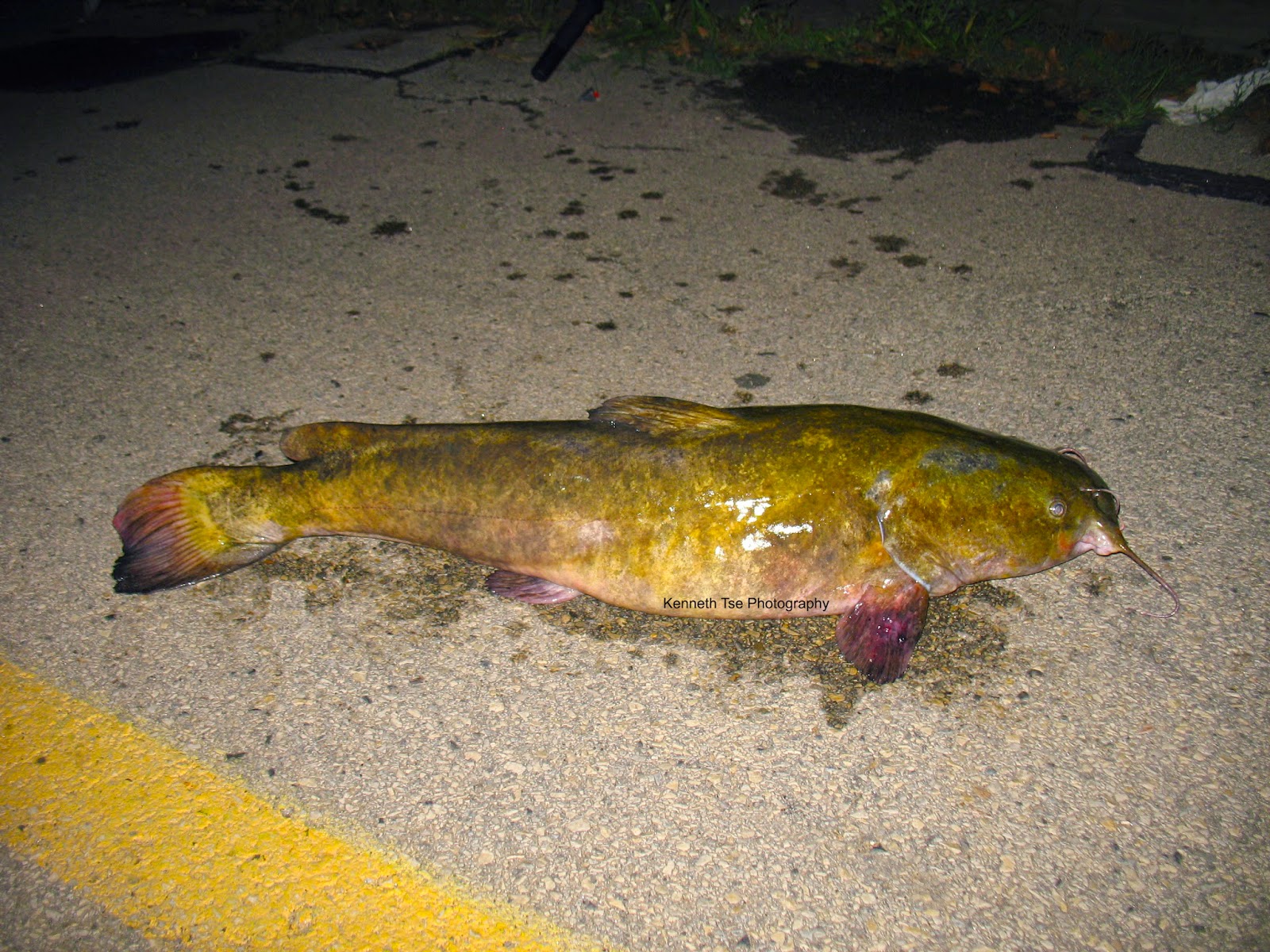
Once again trying to get my eel rod into the water, I had just casted the rod out and settled down for the wait when my catfish rod took a hit again! This time, I got to it quickly, removed the leash, engaged the reel...and felt the line tightened and then stuck. I'm running out of patience...but I decided to give the fish just a little line and wait it out. Luckily, the fish decided to cooperate and came out almost instantly. The rod was loaded up nicely and this was a sizeable fish. At this point, I had no idea if it was a party spoiling Channel Catfish, or the celebration worthy Flathead Catfish. When I finally see some colour, it was clear that this was another decent Flathead Catfish. Matt came over with the net again and netted the fish for me.

Flathead Catfish (Pylodictis olivaris) - Species #399

Matt and I took a picture together with the catfish. Thank you very much, Matt! We owe you big time!

Now that I've checked off the Flathead Catfish, my attention switched fully to American Eel. As my luck would have it, we're running out of worms for bait, since most of the worms were used for catching sunfish. There were two worms left...one was rather limp, very dead and a bit stinky; the other was still lively and fresh. I finally used up the lively worm, and now started using the Spotfin Shiner we had caught earlier.

By now it was already 12am. Pat and Matt decided to call it a night and meet us at Cape May next morning. I told them we may very well continue with the night eel fishing session, so perhaps we'll leave at 6am. Pat and Matt decided to leave at 5am to check things out.

Michael and I decided to try a spot that was suggested to me. It was a creek that flows into the Delaware system. We packed up and started the 30 minutes drive to the creek. The weather was great all evening...but now it started to rain again. It started as a gentle spit which I didn't mind at all. But closer to our destination, it began to rain steadily and moderately heavy. I simply had it and threw a fit in the car. Man, I was pissed at that moment!

I wasn't about to give up. I was pissed but I'm damned determined and stubborn. So onwards we went to the creek. We only had one stinky worm left, so we decided to try out different baits. In Pennsylvania, you are allowed 3 rods in freshwater. However, Michael offered me his rods as well to maximize my chances. He also started looking for nightcrawlers in the wet grassy areas. I know I said some not so nice things in the car. And I felt totally guilty at that point...

Anyways, we set up 4 rods with various baits. Half chunk of stinky worm, half chunk of Spotfin Shiner, a piece of squid and the last rod with a fresh nightcrawler that Michael found. Since there was a current, the rigs occasionally found a snag on bottom. I snapped off one rig and was now down to three. I could have re-rigged, but we didn't have enough bait, so fishing 4 lines was not possible.

I was holding the rod with the live nightcrawler in hand when I felt a little tap, then another tap. I fed the fish some line, expecting the tentative bite of an eel. When I set the hook and felt the fish, the struggle felt a bit like an eel, twisting and turning...but disappointingly, it was a Smallmouth Bass.

I put on the last half of the fresh nightcrawler and went back to holding the rod in hand. Not long later, I heard line pulling on one of the other rods. I could see one rod shaking and quickly grabbed it. A hookset wasn't even requied as the fish was already running down the shallow riffles. When I lifted it out of the water, I could see a long, wriggling shape that quickly balled up into a tangle mess. Yes! This is it! My American Eel!!!

American Eel (Anguilla rostrata) - Species #400!!!

It was very apt to place this American Eel as my 400th species! It epitomizes my journey in species hunting. Most of the time, it has been an uphill battle. Sure, we all get a lucky catch here and there, but most of the time, it required countless nights of research, communication with fellow anglers on their success, mapping out possible locations, and a lot of trial and error before a new species was caught. The American Eel was no different. They are endangered in Ontario and at a number so few that it's almost foolish to target them locally. I had first seen one in the wild in Maryland, but I suspected that this fish was a used bait that was recovering in the cracks of a jetty. I could see the nose of the fish was injured, typical of the nose-hooking manner used to fish eel bait. Ever since, I've tried to fish for them with Pat in Virginia, and even planned to fish for them this year in Kingston with Eli. However, our cool summer seemed to have delayed the arrival of fish and we missed out of the weekend that was available for us to put in an effort. I've sustained so much traffic delay and weather issues on this trip, and sacrificed so much needed sleep to put in an effort to catch some difficult lifers. There was really no word to describe the feeling of the moment when I finally caught the American Eel.

With the target acquired and goal accomplished, it was time to call it a night. It was a little after 3pm when we rolled into our hotel. We would again have a little over 3 hours of sleep before morning.

August 1, 2014

2014 Pennsylvania and New Jersey (Day 1)

I haven't made any travel plans this year since I've been putting an effort to graduate before the end of this year. This trip was very much an impromptu arrangement, very much like the Virginia trip back in May.

Originally, the plan was very simple - stay with my friend Shane in Philadelphia and fish around town for Flathead Catfish and American Eel. But then I started chatting with Pat about it and he planted little seeds into my head...and soon we have a full blown fishing expedition in the works.

As in my typical fashion, this trip was completely packed to the brim on the fishing itinerary. There was a lot to do in very little time, so weather needs to be favourable and traffic needs to be light. Let me just say that from the start, everything was working against us.

After work on Thursday, Michael and I left Toronto as soon as we could. Driving out of Toronto, for the most part, was as expected with a bit of rush hour traffic but not too bad. When we were on the QEW around Oakville, disaster stuck! First, it was an accident involving a couple of truck causing about 30 minutes of delay. As we got close to the Skyway Bridge in Hamilton, traffic came to a very slow crawl. Apparently, a dump truck had driven onto the bridge with the truck bed completely upright, taking out part of the overhead bridge structure. Falling debris collapsed on a transport truck in the neighbouring lane and stopped it on the spot. The entire Toronto bound lanes were closed, and our side of the highway was partially closed. We were delayed for another hour or so.

Luckily, the border was surprisingly smooth. It seemed like the border guard was having a great day and basically waved us into the US without much question. Last time we drove to Florida, we were almost interrogated and we were asked to turn off the car and open our trunk for inspection. It was nice to was shooed in so easily this time.

We felt terrible pulling into Anthony's driveway at 1am in the morning. However, he was very accommodating and offered us a couple of great couches for a short stay. We had 3 hours of sleep before hitting the road again at 4:30am, arriving in Sandy Hook at 7am after getting some bait and local fishing intel at Giglios Bait and Tackle. The store was run by an old salt. He was very knowledgeable and shared with us some local fishing tips.

Our plan at Sandy Hook was to try the salt marsh on the bay side first thing in the morning, then fish the jetty along Fort Hancock as the tide floods in. However, we met a man walking his awesome Australian Sheppard puppy at the parking and he suggested fishing the tip. So we made some plan adjustment for the latter part of the morning.

I was expecting to find more species in the salt marsh. We could see school of smaller fish and quickly discovered they were Mummichog and Atlantic Silverside. We each caught some and kept a few as bait. I was a bit disappointed that we didn't find any Striped Killifish or Sheepshead Minnow in the marsh.

We then fished the bay area, hoping to find searobin in the shallow bay. Instead, we found unlimited amount of Bluefish that were cookie cutter 6-7 inches long. These are often referred as Snapper Blues. They were fun on light gear, but with these aggressive fish around, we couldn't fish for searobin. I poked around some rocks to see if an Oyster Toadfish could be located, but all I caught were more Snapper Blues and a snagged Norther Puffer.

As high tide was 12pm, we moved away from the marsh at 10am. We got there just as the last hour of high tide came in. We chatted with a family to see what they have caught. When they reported the Snapper Blues were thick in the area, the outlook wasn't good. However, the flooding tide seems to push out the bluefish and in came Summer Flounder and Striped Searobin.

Michael and I both tossed out two heavier rigs for the potential sharks and rays. We were allows 3 rods in New Jersey saltwater, so we both had one rod in hand to fish for Summer Flounder and searobin. As I was casting out one of the heavier rod, my Tsunami spinning rod snapped in mid cast. I was very frustrated since this was going to be one of my work horse rod for the weekend. I had no immediate replacement and I was down to only one heavy rod and one surf rod to fish at Sandy Hook.

We watched as the young kid beside us outfished all of us. He was pulling in Summer Flounder and Searobin on the regular. The father and son was using an active retrieve. I had already tried that method but I was still fishless. Michael was soaking strips of squid when he got picked up and landed a Striped Searobin.

I kept alternating between the active retrieve and soaking bait, but it was Summer Flounder after Summer Flounder for me. Meanwhile, Michael also caught a Striped Searobin soaking a Snapper Blue head while my Snapper Blue head was picked up by two Summer Flounder. I just couldn't figure out why I was only catching Flounder while others were catching Searobin, even when I fished shoulder to shoulder beside Michael. It got extremely frustrating and annoying actually...because Searobin was one of my top targets to achieve on this trip and they were supposed to be easy to catch...yet I kept catching Summer Flounder which I've caught many in the past already.

As the tide slacked, the searobin bit slowed to a crawl. In total, Michael caught 5 Striped Searobin and the family beside us caught around 10. I had a big fat zero to show for my efforts. From the distance, we could see and hear a storm brewing. I was adamant to put in a solid effort, even as the storm got closer and closer and we had thunder boomed above our heads and rain started falling. However, by 3pm, we decided it was tactically foolish to put more time in this spot when the fish had obviously shut down. It was time to move.

We were way behind on our itinerary. It was my hope that we could both check off the searobin in a hurry and fish a couple more locations during the afternoon. However, seeing that it was already 3pm, we had very little time left to fish. Our final decision was to scout out Townsends Inlet in anticipation for a solid effort with Pat the following day.

Traffic, once again, threw a wrench in our way. We got on the highway and it was another slow crawl due to an accident. Our estimated 2 hours drive, which would put us in Avalon by 5pm, now turned into more like a 3 hours arrival time. We couldn't waste what little fishing time we had left. During a quick lunch stop, I looked at the map and decided to hit Barnegat Inlet instead since we were already close to the area. It ended up being a semi-decent idea.

We were hoping to find Oyster Toadfish, Tautog and perhaps even Grey Triggerfish along the jetty. However, Cunner ruled the jetty and Michael easily caught his lifer Cunner...and many, many more. I was using bigger hooks so as to avoid hooking the Cunner. However, not much else was found in the rocks. Michael got distracted for a while and started casting for the numerous Bluefish that people were catching on the regular. They were OK size fish around 1.5-3lbs...nothing spectacular so I wasn't really interested at all. But after spending 2 hours of zero action, I tied on a diamond jig and started playing around in the outgoing current. About 10 casts in, I got picked up on the surface and fought a 4lb Striped Bass briefly before it shook its head on the surface and threw the lure back at me. I've caught Striped Bass before so I wasn't bummed at all.

By 7pm, we decided not to waste our time anymore. A relatively quick drive away is a fishing pier popular for night time shark fishing (so I've read). The area was supposed to yield Dusky Smoothhound easily and a good chance at Sandbar Shark. That seemed like a good option so we checked it out as night fell.

Again, we had two heavy rods each for the sharks while using a third light rod to poke around. The shark rods remained pretty quiet with only crabs bugging our bait and weeds dragging our lines. It wasn't until around 11pm when Michael started catching Black Sea Bass and a Northern Searobin using a sabiki tipped with squid. I tried to fish the same spot and even using Michael's rod and sabiki for a Northern Searobin...but only caught Black Sea Bass after Black Sea Bass. As high tide slacked around 12am, the bites stopped. Yet again, I was skunked out on the searobin!

Originally, we wanted to fish for eels on this Friday night. Seeing it had rained on and off in the afternoon and now raining at night, we figured it was best to simply put in more time for these sharks. In Florida, we had most luck with the sharks when the tide was slack. So we were very optimistic during this 12am slack.

However, we didn't even get a single run on the shark rods. I was using a bunker head as bait on one of my rod and it was pretty much crab proof...but even that bunker head was not picked up by a shark. There were two guys and a girl fishing for sharks earlier. They said they fish for them when they are bored, so I assumed they were local and do this regularly. When they packed up after an hour or so effort, it should have been a sight that it was a slow night. I did read the sign...but we were insistent (and optimistic).

It was now 1am and the tide had switched to outgoing. As the water washed out of the bay, it carried a lot of weeds. I was now fishing half of a spider crab as bait (one that Michael caught on his sabiki). I figure the crab was pretty crab proof so it simply let it soak, despite weeds collecting on my line and ever so slowly dragging it downcurrent.

Michael made a note that I should clean the weeds off my rod, but I said "I'll wait until it pulls a little faster." A few strand of weeds was not enough to distract me as I continued to fish the sabiki for searobin.

Finally, the line started singing away as a big clump of weeds caught the line. When I tried to reel in, I could feel the line passing through piles and pile of sea lettuce. The first big clump was stuck on the braid and it took a good 30 seconds to pull all the vegetation off. Finally, I saw my swivel and sinker and there was yet another big clump that had collected. After I cleared the weeds, I felt the line moving and thought it was simply the 4oz sinking swaying on the line. As I brought the line up by hand (I was using a 4' rub leader plus a 3' wire bite leader), I saw a little brown thing on the hook. Oh my...it was an Oyster Toadfish!!!

This was the craziest catch! This Oyster Toadfish was no bigger than 9" long, yet it had taken in half a spider crab and was hooked by a 9/0 J hook. I don't even know how long it had been on the line, since I had let that crab soak for at least an hour. Luck or not, I'll take this fish on my list!

Oyster Toadfish (Opsanus tau) - Species #395

The many faces of the Oyster Toadfish

This single fish saved my otherwise very unassuming and unaccomplished day. We stuck around for another hour hoping Michael can have the same luck, but by 1:30am, we were simply had to call it a night. We had to pick up Pat at the bus station at 8am tomorrow, and the hotel was still another 1.5 hours way.

When we arrive at the hotel, Pat messaged me to say his bus was full and his only option was the train. The train would arrive at 7:16am, which meant we had to get up by 6am. In the end, Michael and I only had a little under 3 hours of sleep.